
What Is ITAD? A UK Business Guide to IT Asset Disposition
Sooner or later, every business ends up with a cupboard, a comms room or a corner of the warehouse full of IT nobody uses. Laptops from the last refresh. A pair of switches pulled out during a network upgrade. Servers that were replaced two years ago and have sat under a dust sheet ever since. What happens to that equipment next is what ITAD is all about, and getting it wrong can cost far more than the hardware was ever worth.
This guide answers the questions UK businesses ask most often about ITAD: what it means, what the process looks like, which laws apply and how to choose a provider you can trust.
What is ITAD? ITAD stands for IT asset disposition. It is the secure, documented process of retiring IT equipment a business no longer needs. Data is erased or destroyed, then the hardware is reused, resold or recycled in line with UK data protection and environmental law, with certificates to prove every step.
What does ITAD stand for?
ITAD is short for IT asset disposition. You will also see it written as IT asset disposal, and in everyday conversation the two terms are used interchangeably.
Strictly speaking, “disposition” is the wider term. Disposal suggests the kit is simply got rid of. Disposition covers every possible outcome for an asset at the end of its working life with you, whether that is redeployment elsewhere in the business, resale, parts harvesting or recycling.
The key word is “asset”. A retired laptop is not just waste. It may still hold customer records, it has a serial number on your asset register and it may still be worth something. Good ITAD treats it that way right up to the end, which is the approach behind professional IT asset disposal services for UK businesses.
Why does ITAD matter for business?
Three risks sit behind every piece of redundant IT, and ITAD for business exists to manage all three together.
Data risk. Hard drives, SSDs, phones and even network switches hold data long after they are unplugged, and a basic reset does not always remove it properly. If a device carrying personal data is lost, sold or dumped without being sanitised, that can amount to a personal data breach under UK GDPR. The Information Commissioner’s Office can fine up to £17.5 million or 4% of annual global turnover, whichever is higher, and the reputational damage usually outlasts the fine.
Legal and environmental risk. Old IT counts as waste electrical and electronic equipment (WEEE). Under the waste duty of care, your business stays responsible for that waste until it is properly recovered or disposed of, even after someone else has taken it away. Handing it to an unlicensed collector does not make the problem theirs.
Financial risk. Kit that goes in a skip is worth nothing. Kit that is wiped, tested and resold can pay back part of the cost of its replacement. With servers, memory and enterprise networking, the return is often better than people expect.
The wider picture matters too. According to the Global E-waste Monitor 2024, the world generated 62 million tonnes of e-waste in 2022, and only 22.3% of it was documented as properly collected and recycled.

What does the ITAD process involve?
Providers describe their service in different ways, but a sound IT asset disposition programme nearly always follows the same seven stages. Use this as a step-by-step guide when planning your next refresh or clear-out.
- Audit and inventory. Every asset is listed by make, model and serial number, and anything that stores data is flagged. This list becomes the backbone of your audit trail.
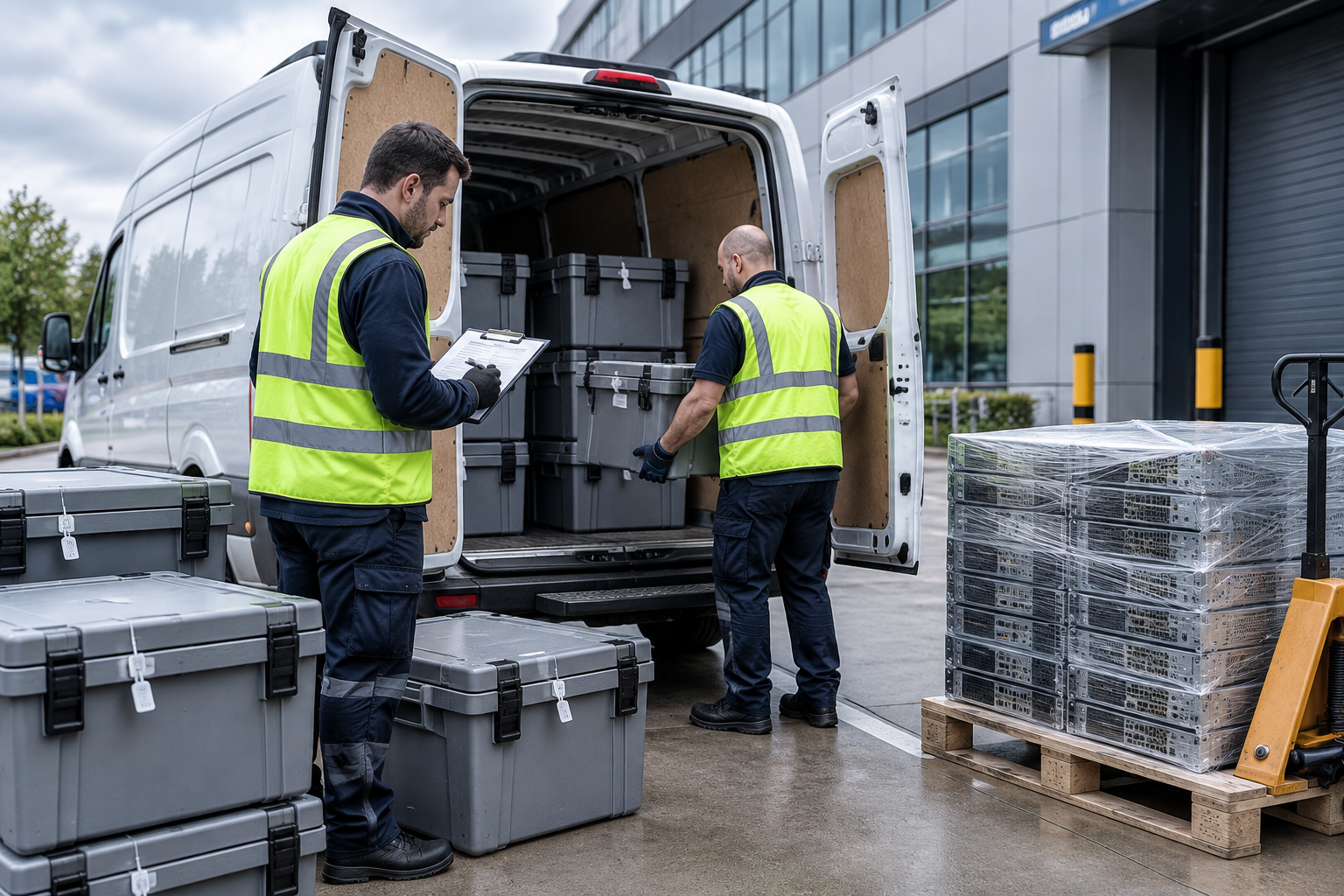
- Secure collection. Equipment is packed, sealed and moved by a registered waste carrier, with a signed chain of custody from your site to the processing facility. Some organisations prefer on-site erasure or shredding before anything leaves the building.
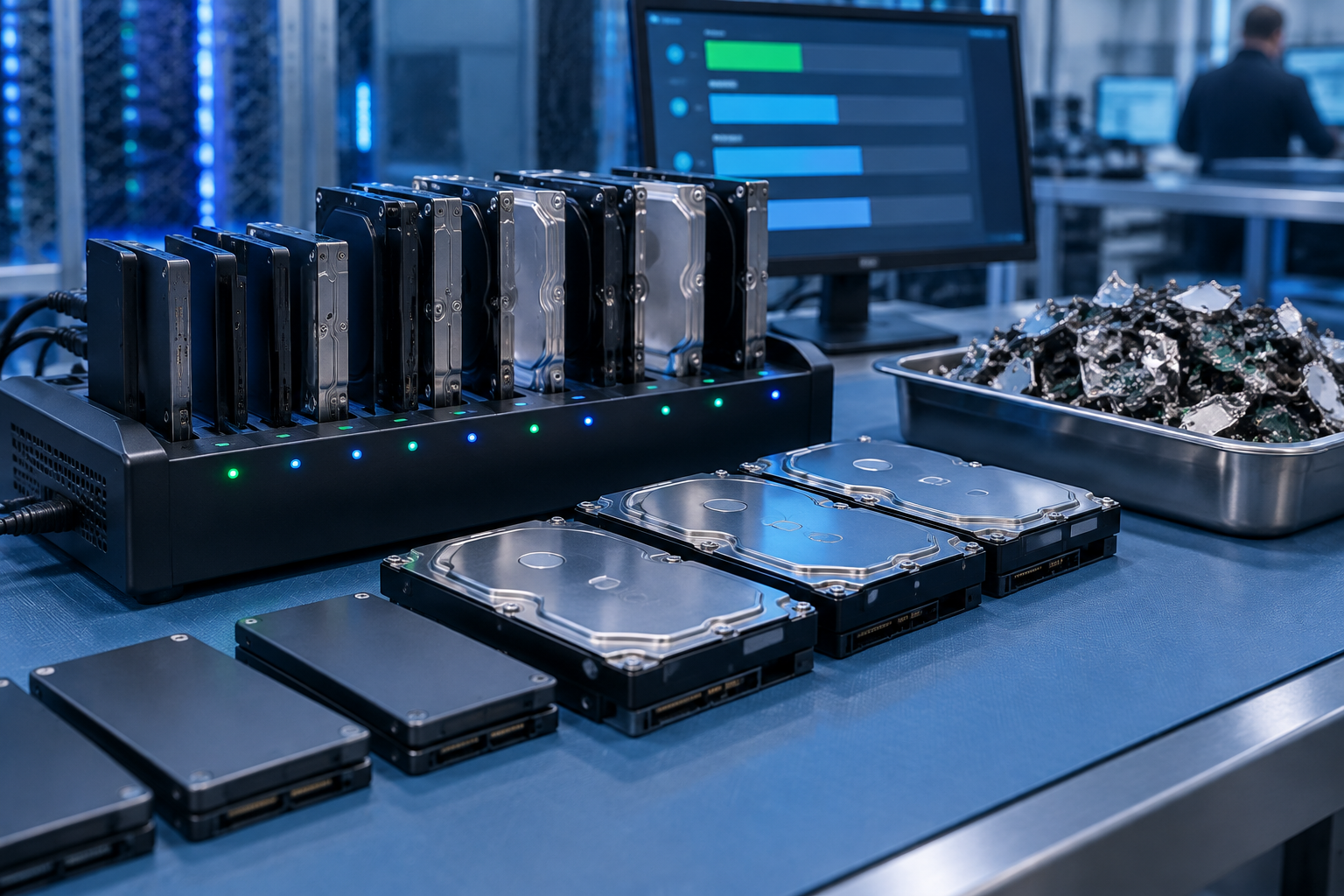
- Data sanitisation. Drives are wiped with verified software, or physically destroyed where wiping is not possible or not acceptable. Each result is matched back to a serial number.
- Testing and grading. Working equipment is tested and graded by condition so its reuse or resale value can be judged fairly.
- Redeploy or remarket. Good kit either goes back into your business or is sold on the secondary market, with the proceeds credited or shared with you.
- Recycle what is left. Anything beyond economic repair is dismantled and separated into metals, plastics and other materials for recovery rather than landfill.
- Certification and reporting. You receive a data destruction certificate, waste paperwork and a final report that ties every serial number to what happened to it.
That last stage is the one auditors and insurers ask for. Our guide to building a defensible ITAD record explains what a complete record should contain.
How is ITAD different from recycling or disposal?
People often assume ITAD is just a posh word for recycling. It is not. The table below compares the three routes a business can take with old equipment.
| Standard disposal | WEEE recycling only | Full ITAD | |
| What happens to data | Nothing. Drives leave the building with data intact | Often shredded with the kit, but rarely certified device by device | Verified erasure or destruction, certified by serial number |
| Paperwork you receive | Usually none | A waste transfer note | Asset report, destruction certificates and waste paperwork |
| Equipment reuse | None | Materials only | Devices redeployed or resold wherever possible |
| Value returned | None | Little or none, sometimes a collection charge | Resale value credited or shared with you |
| Compliance position | High risk under UK GDPR and the duty of care | Covers waste law but leaves gaps on data | Built to cover data protection and waste law together |
| Best suited to | Not recommended for any business IT | Broken items with no storage, such as cables and peripherals | Any equipment that stores data or still has value |
In short, recycling deals with the materials and ITAD deals with the whole asset, including the data on it and the value left in it.

Which UK laws apply to IT asset disposition?
No single law is called “the ITAD law”. Instead, several sets of rules overlap, and a good provider helps you meet all of them.
- UK GDPR and the Data Protection Act 2018. Personal data must be protected with appropriate technical and organisational measures, and that duty continues until the data is gone from every device.
- The Waste Electrical and Electronic Equipment Regulations 2013. These set the rules for separate collection and proper treatment of electrical waste. The government’s WEEE guidance covers the detail.
- The waste duty of care. Section 34 of the Environmental Protection Act 1990 requires you to pass waste only to an authorised person and to keep waste transfer notes for at least two years.
- Hazardous waste rules. Some WEEE is classed as hazardous, for example certain batteries and older display equipment. In England and Wales it moves under a consignment note, and those records are kept for three years. Scotland and Northern Ireland have their own versions of these rules.
- NCSC guidance. The National Cyber Security Centre’s advice on secure sanitisation of storage media is not law, but it is the reference point most UK security teams work to.
A quick practical check: any company collecting your IT should appear on the Environment Agency’s public register of waste carriers. Equipment HQ, for example, is registered under CBDU139943.
What equipment should go through ITAD?
If it stores data or configuration, it belongs in an ITAD programme. That list is longer than most people think.
- Laptops, desktops, thin clients and all-in-one PCs
- Servers, storage arrays and backup tape libraries (see our guide to ITAD for storage arrays)
- Switches, routers and firewalls, which can hold passwords, VPN keys and network maps
- Mobile phones and tablets
- Multifunction printers and copiers with internal hard drives
- IP phones and conferencing units that cache contacts and call logs
- UPS units and batteries, which carry no data but need specialist handling
Should data be erased or should drives be destroyed?
Both are legitimate, and the right answer depends on the drive and your risk appetite.
Verified software erasure overwrites or cryptographically resets the storage, then produces a certificate for each serial number. Because the drive survives, the device keeps its resale value. Physical destruction (shredding or disintegration) is the right choice for failed drives that cannot be wiped, or where a contract or policy insists on it.
SSDs need extra care. Wear levelling means a simple overwrite can miss data, so purge-level methods such as firmware secure erase or cryptographic erase are used instead. The most common standard referenced in UK contracts is NIST SP 800-88, and older tenders still mention HMG IS5. Both are explained in data erasure standards in plain English, and there is more on the commercial side in secure data wiping that protects resale value.
How do you choose an ITAD provider in the UK?
The cheapest collection quote is rarely the safest. Ask these questions before you sign anything.
- Are you a registered waste carrier, and can I check your number on the public register?
- Which erasure standard do you use, and will I get a certificate for every serial number?
- Do you hold ADISA certification, or ISO 27001 and ISO 14001?
- How is chain of custody recorded from the moment kit leaves my site?
- Where does equipment go after processing, and is any of it exported?
- How is resale value calculated and shared, and when is it paid?
- Can you erase or destroy drives on site if our policy requires it?
A provider who answers all seven clearly, and in writing, is usually one you can trust with sensitive kit. You can see how these points are handled in practice on our ITAD services page and in the zero landfill ITAD programme.
Does ITAD cost money or make money?
It depends on what you have. Age, specification, quantity and condition all affect the outcome.
Recent servers, high-capacity memory and enterprise networking equipment often cover the full cost of collection and processing, then return money on top. Older laptops and desktops may only offset part of the cost. Anything broken or obsolete mainly carries a compliance value, since it keeps you on the right side of the law.
If you have surplus equipment that still works, you can sell your used IT equipment outright, or place larger volumes into the Split Share Scheme, where stock is sold on your behalf with monthly reporting. For guidance on pricing, see how to benchmark a fair server buy-back offer.
Frequently asked questions about ITAD
Is ITAD a legal requirement for UK businesses?
No law uses the word ITAD. However, UK GDPR and the waste duty of care together require what ITAD delivers: secure data removal and lawful, documented handling of electrical waste.
Is a factory reset enough before selling a laptop?
Only sometimes. On a fully encrypted device, a reset that destroys the encryption key can be enough. On unencrypted drives it may leave recoverable data, and either way it gives you no proof. For business kit, verified erasure with a certificate is the safer choice.
How long should ITAD records be kept?
Waste transfer notes must be kept for at least two years, and hazardous waste consignment notes for three. Many organisations keep data destruction certificates for longer, in line with their own retention policy.
Can ITAD help with ESG and carbon reporting?
Yes. Reusing equipment avoids the emissions of manufacturing a replacement, and a good provider will report weights, reuse rates and recycling outcomes. There is more detail in our guide to environmental reporting for server recycling projects.
Is ITAD only worth it for large companies?
No. ITAD for business works at any scale. A small office retiring ten laptops carries the same data risk per device as a large enterprise, so the process is simply scaled down to suit.
Planning your next IT refresh?
ITAD is not an afterthought to a hardware refresh. It is the part that protects your data, keeps you compliant and gives some of your investment back. Start with an accurate inventory, insist on certificates, and choose a partner who can show you where every device ends up.
Equipment HQ provides secure ITAD for business across the UK, covering certified data erasure, asset recovery, refurbishment and WEEE compliant computer recycling. To discuss your equipment, contact the team for a no-obligation assessment.