

The DDR4 to DDR5 Transition at a Glance
DDR5 lifts bandwidth and moves power management onto the module (PMIC), helping memory‑hungry AI and high‑core‑count CPUs. It is not yet universal: most x86 servers in production still run DDR4.
RDIMM (registered DIMM) adds a register to stabilise signalling and support higher capacities per channel. LRDIMM (load‑reduced DIMM) adds a buffer to further cut electrical load and reach the largest densities. Both are ECC. This guide helps IT managers, data centre ops, procurement and ITAD leads recover, grade and resell DDR4 safely and for the best price.
Why DDR4 RDIMM/LRDIMM Stays in Demand During AI Rollouts
There are millions of DDR4‑capable servers in the field (Intel Xeon Scalable up to Ice Lake; AMD EPYC Naples/Rome). Support windows, contracts and SLAs keep fleets active, so spare‑parts demand and supply remain strong.
While AI GPU nodes often move to DDR5, the supporting layers commonly stay on DDR4 for cost and availability:
- Virtualisation clusters and VDI
- Storage and backup targets
- VNF/telecom and edge infrastructure
- Dev/test and lab environments
DDR4 offers predictable performance, short lead times and strong TCO. For uptime planning and spares strategy, see server maintenance what to know and where to start.
What Impacts DDR4 RDIMM/LRDIMM Buyback Price
- Capacity, speed and rank: common sizes are 8/16/32/64/128 GB; speeds from DDR4‑2133 to 3200; typical ranks include 1Rx4, 2Rx4 and 4Rx4.
- IC vendor and matching lots: Samsung, SK hynix and Micron carry strong liquidity; matched date codes and lots reduce return risk.
- OEM badges: HPE/Dell/Lenovo part numbers can carry a premium for OEM‑locked estates.
- Condition: intact heatspreaders, clean pads, readable stickers and no bent edges increase price per DIMM.
- High‑liquidity parts: 32 GB 2Rx4 2400–3200 RDIMM, 64 GB 4Rx4 2666–3200 LRDIMM and 128 GB LRDIMM sell fastest.
- Timing: prices move when hyperscalers offload stock; monitor market waves.
For wider selling context, read why you should sell your old business IT hardware.
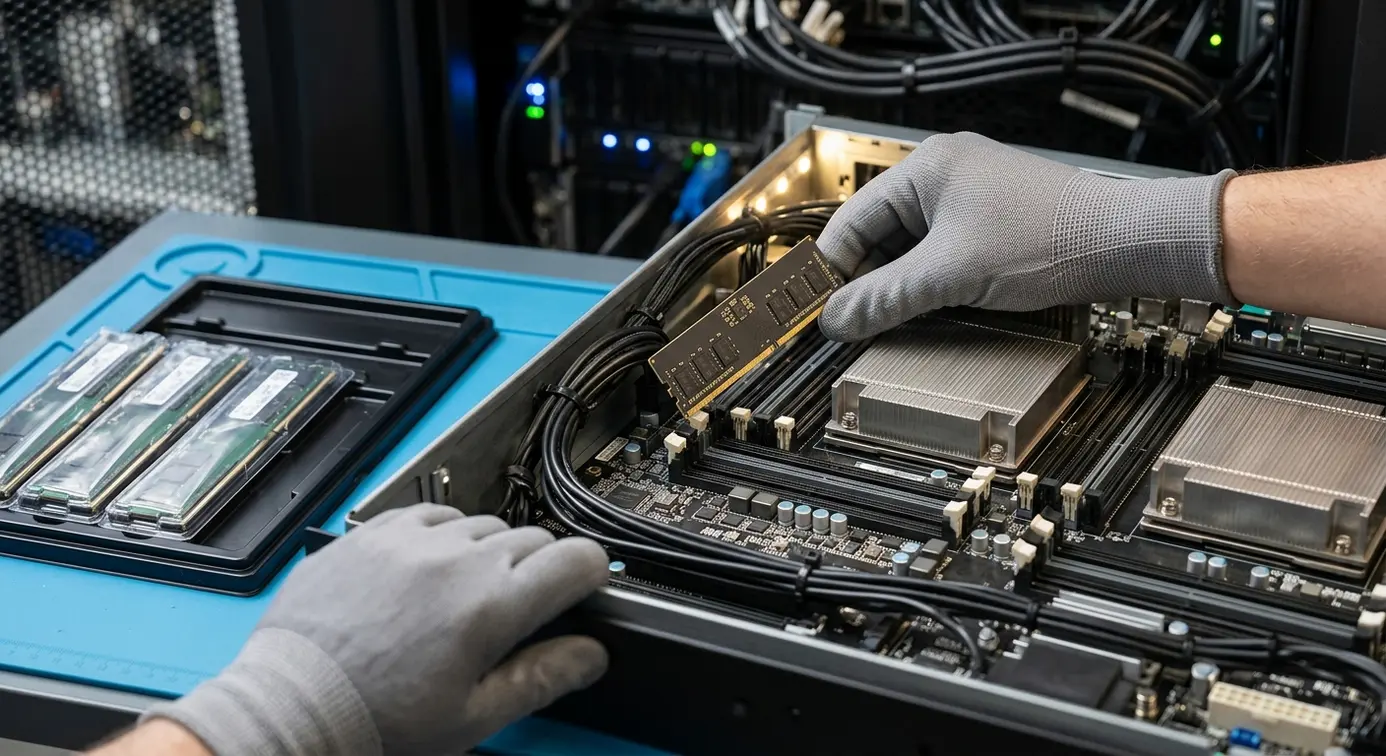
This image was generated with AI and may not always represent the product or service exactly.
RDIMM vs LRDIMM: Avoid Costly Mix‑Ups
- RDIMM uses a register; LRDIMM uses a buffer to further isolate the controller from the DRAM chips.
- Do not mix RDIMM and LRDIMM in the same channel or motherboard. Treat them as separate part streams.
- Platform notes: Intel Xeon Scalable (Skylake to Ice Lake) and AMD EPYC (Naples to Rome) support DDR4 RDIMM or LRDIMM, but not both together.
- Mixed speed bins down‑clock to the slowest DIMM; density limits can also apply.
- Quick ID checks: “2Rx4” is usually RDIMM; “4Rx4” is typically LRDIMM. Label codes and OEM P/Ns confirm type.
Professional Grading Standards for Used Server Memory
Cosmetic grades:
- A: clean heatspreader, intact labels, no corrosion.
- B: minor scuffs or worn labels.
- C: heavy wear, dents or significant label damage.
Functional grading:
- Full pass at rated JEDEC speed.
- Stable only at a lower speed (down‑binned).
- Fail/intermittent.
SPD integrity is verified and corrected where allowed so JEDEC fields match the label. Creating matched kits (same P/N, capacity, rank and speed) lifts price per DIMM and shortens time to sell.
How Certified Testing Works in Our Lab
- ESD‑safe intake, barcode capture and SPD dump, followed by visual inspection under magnification.
- Supermicro/Tyan benches run MemTest86 at target JEDEC speed with thermal soak.
- We log errors, confirm SPD and apply clear pass/fail criteria.
- You receive batch reports with serial ranges, cosmetic/functional grades and yield. Warranty terms are agreed per lot.
- RAM is volatile and holds no data when unpowered; we still use sealed transport and full chain of custody. For security best practice, see how to avoid security issues when recycling network hardware.
Prepare Your DIMMs to Maximise Resale Value
- Build an inventory with P/N, capacity, speed, rank, IC vendor, OEM badge, quantity and condition.
- Sort into identical lots; do not mix RDIMM with LRDIMM. Keep labels intact and photograph a clear sample from each lot.
- Handle with ESD control. Remove dust gently; avoid solvents.
- Pack in antistatic bags or JEDEC trays; cushion with foam in sturdy cartons.
- Label each lot and include counts. We can arrange insured collection and provide full receiving reports via ITAD services for businesses.
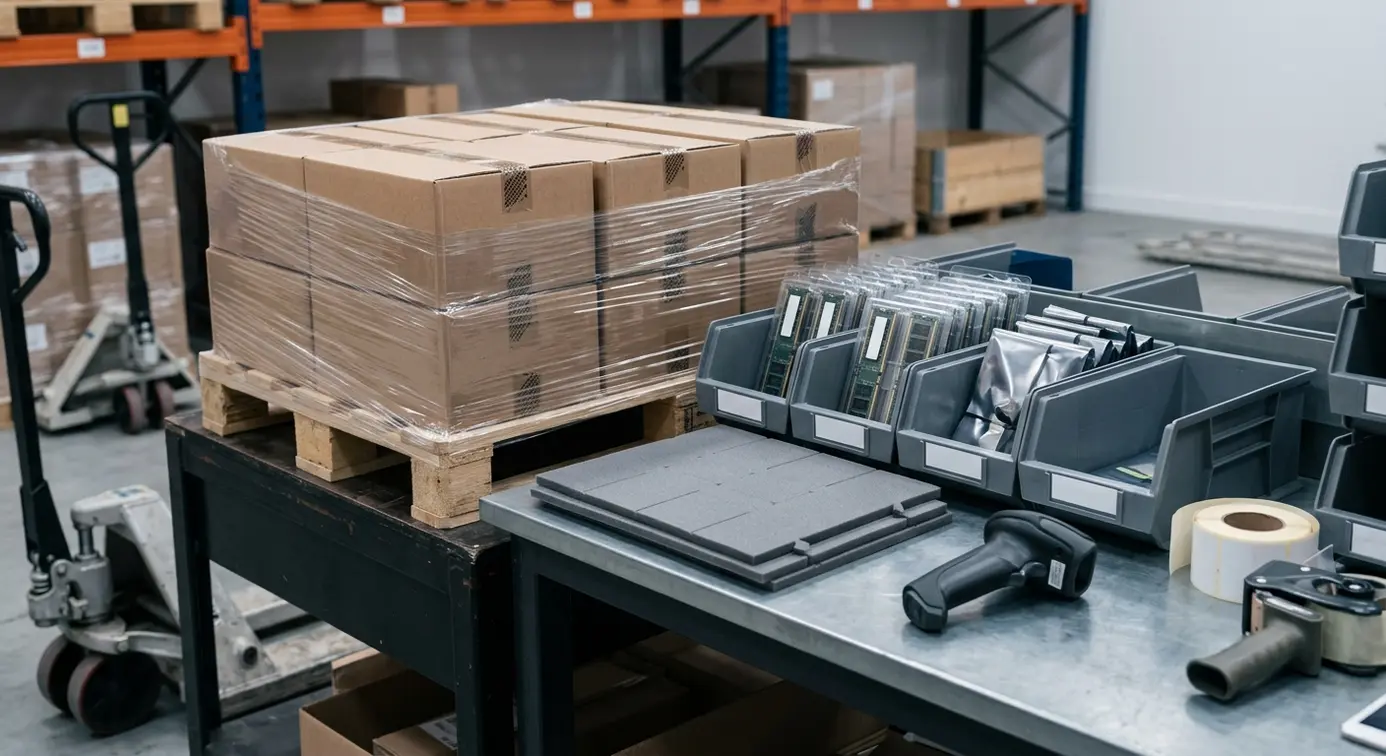
This image was generated with AI and may not always represent the product or service exactly.
Compliance, Sustainability and Data Security
Prioritise reuse. Working DIMMs should be redeployed; only failed units go to material recovery. This delivers the best environmental outcome and supports WEEE compliance.
We provide audit trails, test certificates and insured, tracked transport. RAM is volatile and does not require data wiping, but full ITAD projects include certified erasure for storage devices. For disposal pathways across your wider estate, see IT hardware disposal options explained.
Choosing a DDR4 Buyback Partner: Questions to Ask
- Testing: methods used, thermal soak duration, pass/fail criteria.
- Reporting: batch reports, grading policy, serial‑range mapping.
- Commercials: warranty length, turnaround time, how failures/deductions are handled, payment timing.
- Logistics: tracked collections, insurance cover, packaging support.
- Remarketing: reach across enterprise, VAR and export; OEM and white‑box expertise.
For supplier selection tips, read what is ITAD and how do I choose my supplier.
Quick FAQs on DDR4 Memory Resale
Does RAM store data when removed?
No. Server RAM is volatile. When power is off, data is lost.
Can I mix brands or speeds in one lot?
You can, but it reduces price and increases return risk. Keep lots uniform by brand, speed, rank and P/N for best value.
Are OEM‑badged DIMMs worth more?
Often yes, in matched HPE/Dell/Lenovo estates. Generic parts sell well into white‑box and mixed fleets.
Note: ECC UDIMMs are not drop‑in replacements for RDIMM/LRDIMM servers; check platform memory type requirements.
Get a Fast DDR4 Buyback Quote and Reliable Supply
Send your inventory spreadsheet and clear photos for a same‑day indicative valuation. We offer free collection on qualifying lots and pay on test with transparent reporting.
Need ongoing DDR4 spares? We supply tested, warranted modules with fast dispatch. For related reading and updates from Equipment HQ, visit our blog.
Equipment HQ DDR4 Buyback: FAQs
How quickly can Equipment HQ test and pay for DDR4 lots?
Most batches are tested within 2–5 working days, depending on size. We pay on test pass and provide a full yield report.
Do you buy mixed conditions or partial trays?
Yes. We grade each DIMM and price by yield and condition. Uniform, matched lots achieve the best rate.
What paperwork do I get for compliance?
You receive collection notes, chain‑of‑custody records, test certificates and a final settlement report. We can map serial ranges to your asset list.
Can you supply matched DDR4 kits with warranty?
Yes. We build matched kits by capacity, rank, speed and OEM badge where needed. All parts are burn‑in tested and warranted.
Do you offer international collections?
We arrange insured, tracked logistics across the UK and EU, and selected global routes. Packaging guidance is provided to prevent transit damage.
What happens to failed modules?
Failed units are isolated and recycled through approved channels. You receive itemised records for audit.
Can you handle combined CPU, RAM and drive disposals?
Yes. We take full server lots. Storage devices receive certified erasure or destruction as specified.