
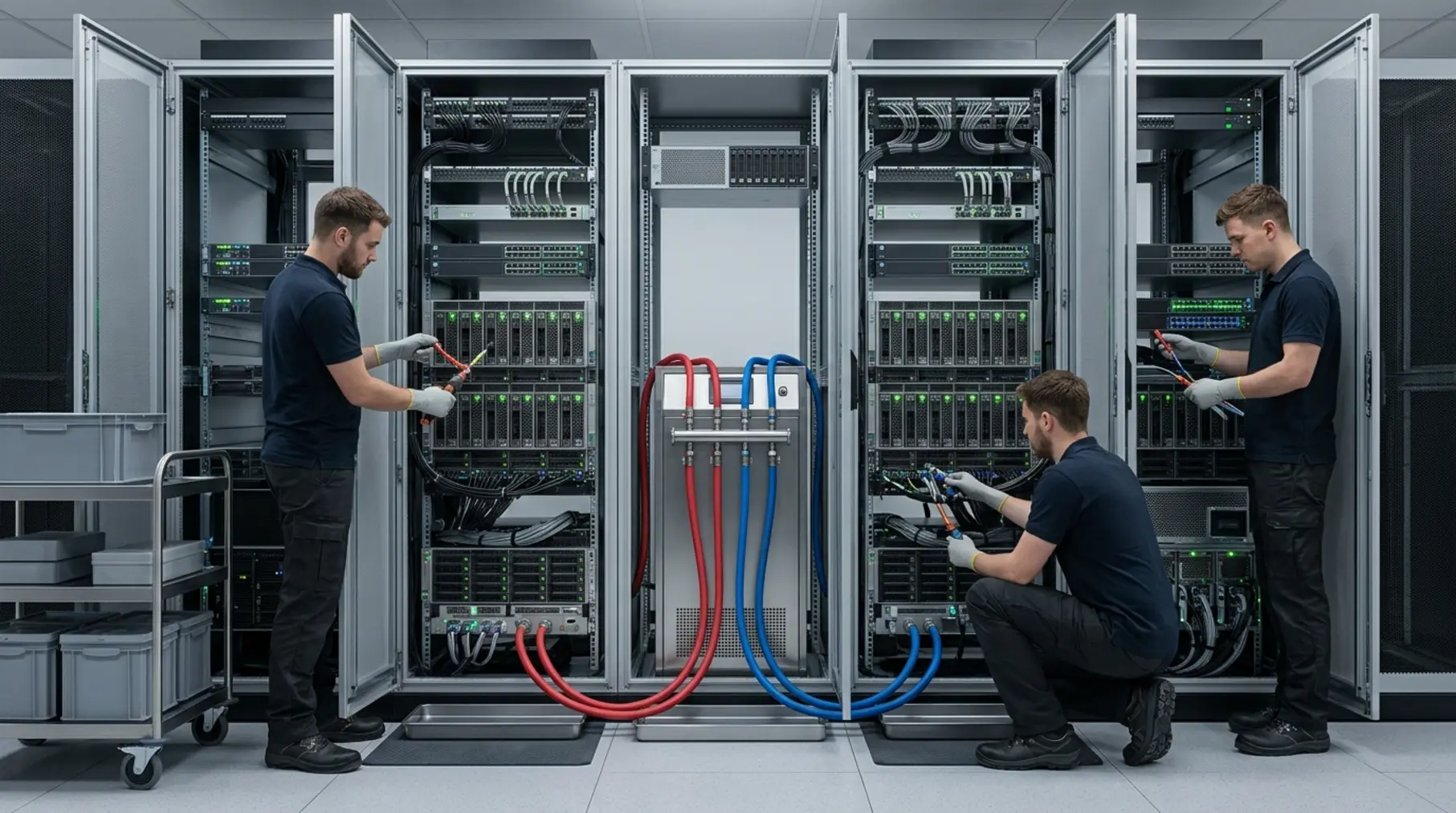
Scope And Architecture Overview
This guide covers safe decommissioning of liquid‑cooled AI racks, including the in‑rack secondary loop, quick disconnects (QDs), manifolds, cold plates, flexible hoses, and the Coolant Distribution Unit (CDU), plus interfaces to the facility (primary) loop.
- Primary loop: building water circuit managed by facilities.
- Secondary loop: closed circuit inside the rack and IT nodes; controlled by the CDU.
- Typical components: CDUs, manifolds, cold plates, QDs, hoses, valves, strainers, and inline filters.
Coolants include water‑glycol blends (conductive) and engineered dielectric fluids (non‑conductive). Handling, testing, and disposal/reclaim pathways differ. Principal risks: fluid leaks, contamination, electrical safety, and data security.
Only trained, certified engineers should perform this work. Follow OEM procedures as the primary reference. For node removal and GPU‑specific risks, see our GPU server decommissioning playbook and guidance on de‑risking H100/H200 server disposals.
Pre‑Works Planning, Permits, And Risk Controls
- Survey and MSRA: confirm rack and CDU models, coolant types/volumes, isolation points, access routes, floor loadings, and power‑down windows.
- LOTO plan: electrical feeds, CDU pumps, and all valves (secondary and any that interface with the primary loop).
- Equipment fit: verify lifts, trolleys, skates, pallets, crates, and door/ lift clearances.
- Spill preparedness: stage spill kits, absorbents, drip trays, bonded pallets, and UN‑rated containers.
- PPE and CoSHH: check SDS/CoSHH for each coolant; brief the team.
- Permits: confirm permits to work and hot‑work rules if cutting/brazing may be required.
- Chain of custody: define roles, reporting lines, and evidence capture; see ITAD chain of custody and environmental reporting for large projects.
Draining The Secondary Loop (In‑Rack): Method Statement
- Power down IT nodes per OEM guidance; then stop CDU secondary pumps.
- Connect a closed reclaim cart or vacuum‑rated vessel to the designated service ports.
- Place trays beneath QDs; release lines in the specified order. Cap each line as it is disconnected.
- Open the highest vent last to control air ingress and prevent splashing.
- Drain to sealed containers. Record rack ID, coolant type, and measured volume on tamper‑evident labels.
- Bag hoses and fittings to prevent drips. Follow OEM torques, port locations, and sequencing.
For adjacent node handling and resale steps, see GPU server decommissioning safe removal.
Flushing And Drying Cold Plates And Manifolds
- Select a flush medium compatible with the existing coolant and OEM materials. For water‑glycol, use OEM‑approved DI water. For dielectric systems, use the specified OEM fluid or compatible solvent.
- Circulate through inline filters; clean or replace strainers. Monitor clarity, conductivity, and particulate until within OEM targets.
- Where required, purge with dry air or nitrogen. Use vacuum‑assist drying for complex cold plates.
- Immediately cap all ports to prevent debris or moisture ingress. Bag assemblies and mark “flushed and dry” with date, rack ID, and technician initials.
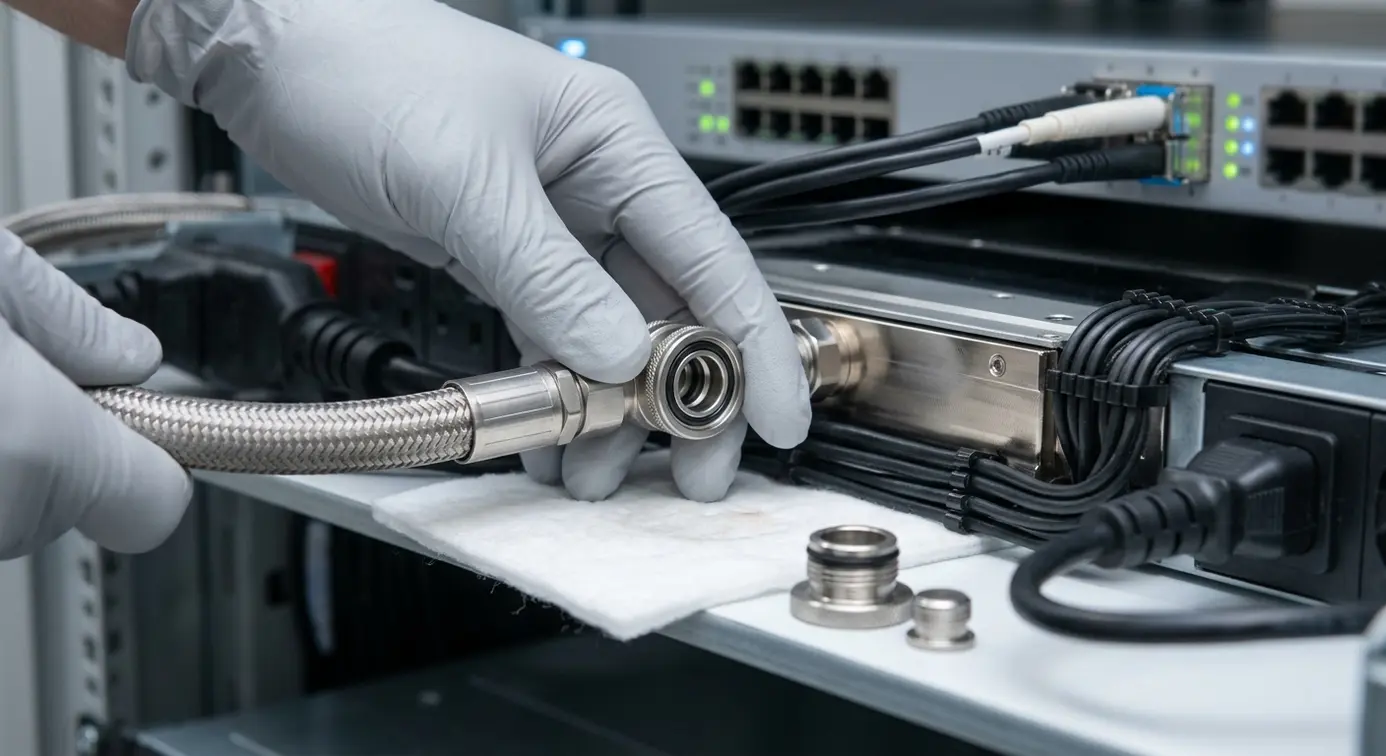
This image was generated with AI and may not always represent the product or service exactly.
CDU Decommissioning: Isolate, Drain, Purge
- Notify facilities. Isolate the CDU from the primary building loop and apply LOTO to electrical feeds and isolation valves.
- Follow the OEM drain sequence: reservoir, heat exchangers, pumps, then headers. Use closed containers on bonded pallets and log volumes/anomalies.
- Remove and clean strainers and filters. Fit IP‑rated caps and transit blanks to all ports.
- Prepare for transport: apply tilt/shock indicators, label residue status, empty weight, and centre of gravity (if known). Keep manuals and service records with the unit.
Packaging And Transport: Racks, CDUs, Hoses, And QDs
- Cap every open line. Double‑bag hoses and QDs (antistatic inner, secondary polythene outer).
- Use drip‑proof crates with absorbent mats. Strap CDUs to pallets with corner protectors and mark anchor points and centre of gravity.
- Store tools and loose parts in labelled kitting boxes. Photograph seal points before loading.
- Containerise fluids in UN‑approved drums or IBCs with correct hazard labels per SDS.
- Prepare Waste Transfer Notes and, where applicable, ADR/Dangerous Goods notes; verify driver ADR status if required.
- Plan the route, lift plan, and vehicle type; confirm floor to vehicle transitions and loading bay timings.
Coolant Handling: Testing, Reclaim, And Reuse Pathways
- Sample with clean bottles; record asset IDs and batch IDs.
- Water‑glycol: test concentration (refractometer), pH, inhibitor level, and particulate to decide on re‑blend, filtration, or distillation.
- Dielectric fluids: measure dielectric strength and moisture; apply fine filtration and vacuum dehydration where suitable.
- Where feasible, return treated coolant to service or send to certified reprocessors. Provide lab results, volumes, destinations, and certificates for ESG reporting. See from audit to certificate.
WEEE Categorisation And Compliant Material Streams
- Classify CDUs, servers, and accessories under IT and telecommunications equipment (WEEE Category 3).
- Segregate streams: ferrous/non‑ferrous metals, plastics, PCBs, batteries/sensors, and cable.
- Keep hoses and items with fluid residues in a bunded area and treat as hazardous until verified clean.
- Bar‑code assets and weigh each stream. Maintain evidence notes and document downstream processors.
- Provide ESG summaries for larger projects with recovery rates and carbon estimates aligned to client reporting frameworks.
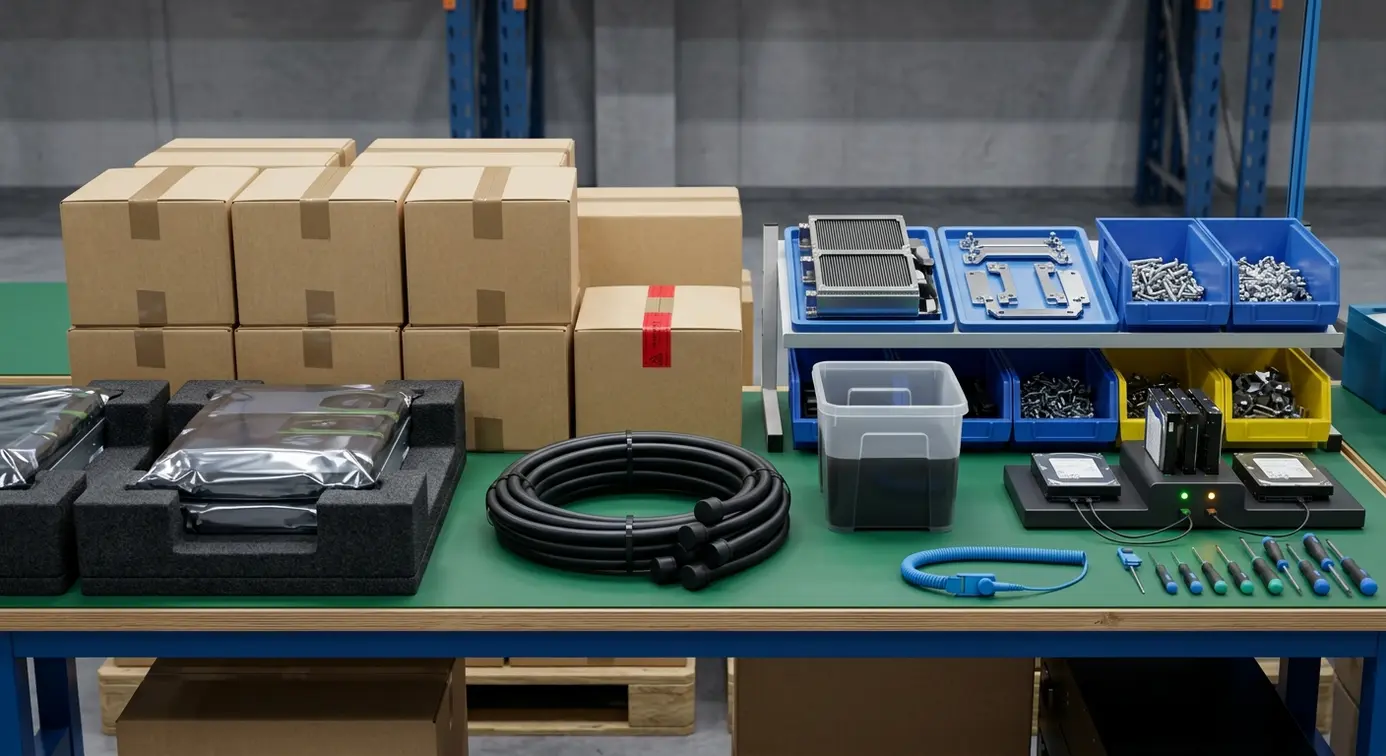
This image was generated with AI and may not always represent the product or service exactly.
Data Security During AI Rack Removal
- Erase NVMe, SSD, and HDD media per NIST 800‑88 or HMG guidance; use cryptographic erase where supported and verify with logs.
- Reset BMCs, remove credentials, and roll back firmware if required by policy.
- Capture serials, photos, and erase reports into the chain of custody. Use sealed totes for secure transit. See sanitising NVMe at scale.
Reuse And Value Recovery: Remarket, Redeploy, Recycle
- Test and grade GPUs, CPUs, memory, NICs, storage, and CDUs; record functional tests, thermals, and cosmetics.
- Redeploy viable node shells, rails, and manifolds; prepare condition reports.
- Offer buyback or consignment to maximise return; route BER items to responsible recycling with verified downstreams.
- Provide a clear decision log to evidence value recovery and waste minimisation.
Documentation Pack And Final Handover
- Signed method statements and risk assessments, CoSHH sheets, fluid analysis, asset lists with serial capture, photos, and WTN/ADR notes.
- Certificates of data erasure/destruction where applicable, plus a concise ESG summary.
- Retained records link batch and asset IDs to coolant, hardware, and data events for audit‑ready compliance.
Why Equipment HQ For Liquid‑Cooling Decommissioning
Equipment HQ deploys certified engineers with multi‑brand experience and OEM‑aligned procedures. We schedule quickly nationwide and manage the full chain: isolate, drain, flush, pack, transport, erase, and report.
We reclaim or responsibly process coolants, manage WEEE correctly, and protect data to recognised standards. Expect clear communication, tidy execution, and a documented handover that stands up to audit.
FAQs
How Long Does A Typical Liquid‑Cooled Rack Decommission Take?
Most single racks complete in one to two shifts, depending on access, fluid volume, and documentation scope. Multi‑rack jobs scale with team size and site constraints.
Can You Reuse Existing CDUs And Manifolds?
Yes—subject to inspection, flushing, and functional testing. We cap, clean, and prepare them for resale or redeployment with condition reports.
What Happens To The Collected Coolant?
We sample and test. Water‑glycol can be re‑blended or distilled; dielectric fluids can be filtered and dehydrated. Otherwise, we send to certified reprocessors with full paperwork.
Do You Work Alongside Facilities Teams On The Primary Loop?
Yes. We coordinate isolation and LOTO with facilities and do not operate primary valves without an agreed permit and method statement.
How Do You Prove Data Has Been Erased?
Each device receives an auditable report tied to serials and asset IDs. We provide certificates and logs aligned to NIST 800‑88 or HMG guidance.
What If A Quick Disconnect Leaks During Removal?
We use trays, absorbents, and caps to contain drips. If a seal fails, we stop, control the spill, replace or cap the fitting, and resume under the method statement.